Reflections
In this section, I take the time to reflect on my teaching and learning experiences. It's a space where I can analyze what worked well, what challenges I faced and how I can improve moving forward. By engaging in this reflective practice, I aim to enhance my skills and foster a deeper understanding of my students' needs. This ongoing journey of self-discovery is essential for my growth as an educator.

Linking Theory to Practice
In my approach to teaching, I draw heavily on teacher-centric educational theories and Confucianism, which emphasize the central role of the educator in guiding and unlocking students' potential. According to Confucian principles, the teacher is not only a knowledge provider but also a role model, whose experiences and wisdom are shared to inspire and lead students. However, this is balanced by a deep respect for students' individual needs and the belief that every student has the capacity to learn and succeed when guided properly.
This belief system informs my use of technology in the classroom. For instance, interactive tools such as Quizizz and Kahoot serve as a practical extension of the Confucian value of engaging with students in meaningful ways. These platforms allow me to listen to students' needs, assess their understanding, and adjust my teaching dynamically. The integration of real-time feedback aligns with the notion that lecturers are guides who facilitate learning, adapting their methods based on the student's journey.
Further, the teacher-centric approach values efficiency and the effective delivery of content, which is why I incorporate Prompt Engineering. This tool allows me to quickly generate resources and stay updated with the latest knowledge, thereby ensuring that I serve as a knowledgeable resource for students, much like the Confucian ideal of a teacher constantly refining their knowledge to support student growth.
In line with the Confucian belief that teachers should lead by example, I use Turnitin to uphold academic integrity, demonstrating the importance of originality and ethical work to my students. Similarly, platforms like Canva for presentations and Capcut and OBS for video recording enable me to present information in engaging ways, ensuring that my teaching methods are not only informative but also visually stimulating, reflecting the Confucian emphasis on holistic development.
Lastly, the use of YouTube, MS Teams, CourseNetworking (CN), and Moodle aligns with my belief in the importance of guiding students through diverse resources and experiences. These tools extend learning beyond the traditional classroom, enabling students to access materials and engage with content at their own pace, fostering independent learning — a key component of Confucianism that highlights self-discipline and continuous learning.
By incorporating these technologies, I not only uphold the teacher's role as a facilitator and role model but also embrace the modern tools that make learning more accessible, interactive, and responsive to students' diverse needs. This balanced approach allows me to support my students' potential, guiding them towards success through both personal engagement and technological innovation.

Student Feedback
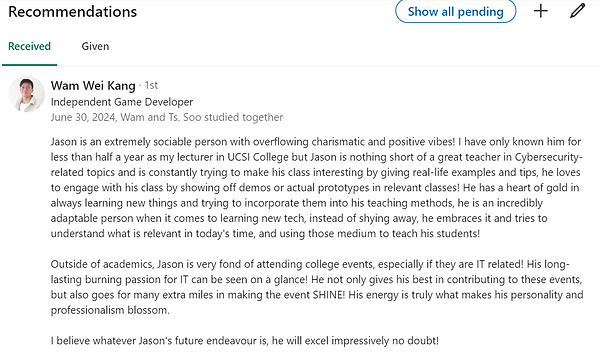


Reflection on Technology-Supported Learning
As I engage with technology-supported learning, I realize that meaningful reflections on its effectiveness require observing its impact throughout the entire student journey—from enrollment to graduation. I believe that true understanding of how technology shapes learning will come only after I have seen how students progress over a complete cycle of their education. Observing them across different phases of their academic journey—adapting, applying, and eventually mastering both content and the tools themselves—will provide the insights necessary to make informed evaluations of which approaches are most effective.
At this stage, what I have learned is that new technology cannot be avoided, and as educators, we must not only embrace it but remain ahead of it. This realization has driven my constant effort to explore and master emerging tools such as Quizizz, Kahoot, and Prompt Engineering. While these tools have proven beneficial in enhancing interaction and speeding up tasks, the process of learning and integrating them has not always been smooth. For instance, while Quizizz and Kahoot have facilitated more engaging lessons, not all students respond equally—some prefer more traditional forms of interaction, a tension I only discovered through continuous trial and reflection.
In retrospect, I see that my use of Prompt Engineering has saved me time, but I am still grappling with how to best align it with students' needs. This tool allows me to provide quicker responses and up-to-date resources, but it raises the question: am I sacrificing depth for speed? It has required me to adjust, sometimes revisiting how I structure lessons to ensure that speed does not undermine quality. Feedback from peers has been invaluable here—especially in pushing me to reflect on the balance between efficiency and effectiveness in the classroom. This has taught me that technology alone does not guarantee better learning outcomes; rather, it must be used in a way that serves the students' unique contexts.
Another key insight has emerged from my experience with Turnitin and academic integrity. While Turnitin helps me uphold standards, I initially underestimated the learning curve students face when using it. Some students struggled with understanding how the tool worked and why it was important, which highlighted the need for more proactive guidance from me as their instructor. Technology is only as effective as the users' understanding of it, and this experience has underscored my responsibility to not just introduce tools, but also mentor students on how to use them effectively.
The feedback from students and colleagues has been crucial in shaping my approach. Initially, I leaned towards using multiple tools simultaneously, but student feedback revealed that this could be overwhelming. They preferred fewer tools, integrated deeply into the learning process, rather than an array of platforms that were not fully explored. This insight has helped me streamline my approach, focusing more on the quality of engagement rather than the quantity of tools.
Looking forward, I believe my reflections will only deepen once I have guided a full cohort through to graduation, witnessing how they evolve not only in knowledge but also in their use of technology. What I’ve learned so far is that technology is a tool for unlocking potential, but its effectiveness lies in how well I can adapt it to meet the diverse needs of my students. Until then, I remain committed to learning and mastering new technologies, so that I can stay ahead of the curve and provide the most up-to-date, relevant education for my students.